Back in 2017, NetLine’s GM David Fortino, then serving as SVP of Audience, offered a piece of advice that was a bit ahead of its time.
“Leads generated by long-form content need time to digest your content. Suggest that your sales team wait 48 hours before contacting to ensure that the prospect is well-informed enough to have an educated discussion.”
He was right in 2017. He’s more right now.
The 48-Hour Rule
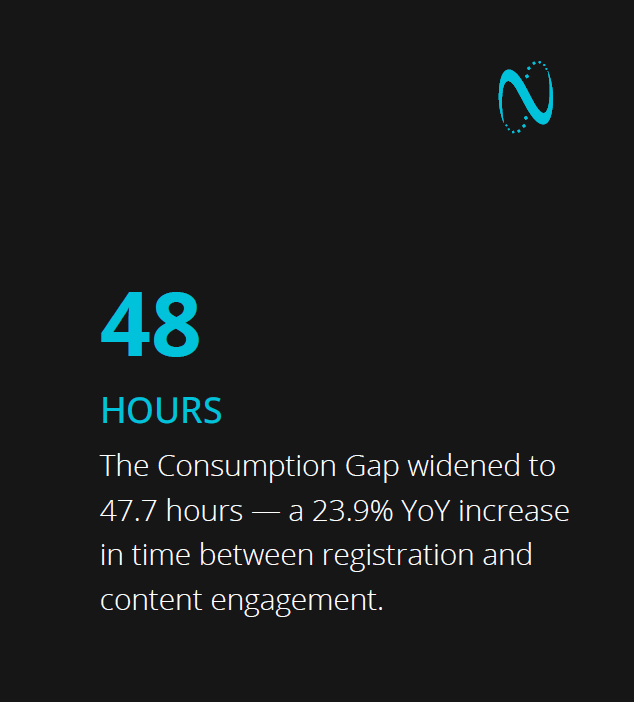
In 2025, the average B2B professional waited 47.7 hours between requesting a piece of content and actually opening it—a 9.2-hour increase year over year, and a 23.9% jump from 2024. We call this period between request and open (download) the Consumption Gap.
This number, as reported in our 2026 State of B2B Content Consumption and Demand Report, represents the widest Consumption Gap NetLine has ever measured in ten years of tracking this behavior.
Truly, the 48-Hour Rule has officially arrived.
A Number That Doesn’t Mean What You Think It Means
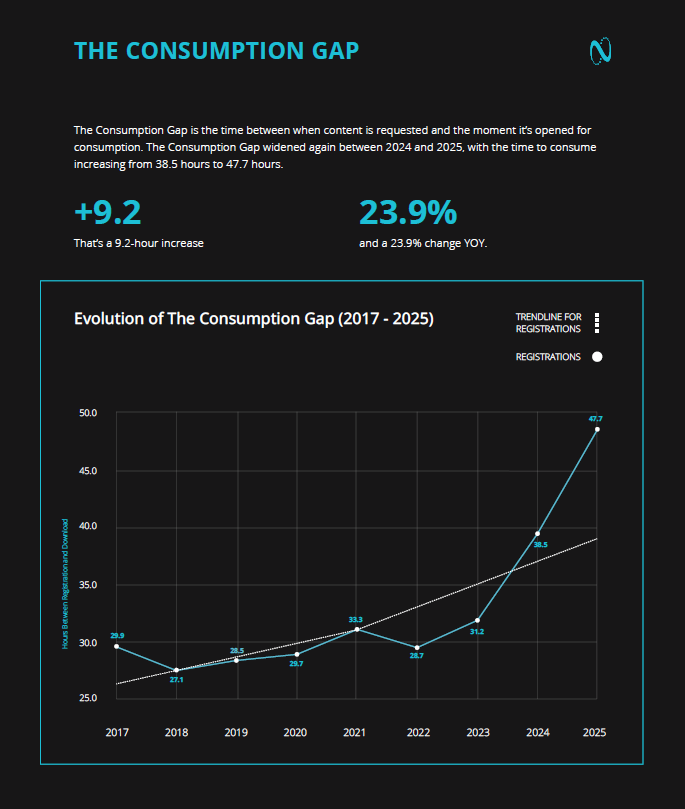
While I may have new requests and ideas for each edition of our reports, the Consumption Gap is the only stat that holds my curiosity throughout the year.
So, when I saw 2025’s average, I had to check my math again. And then another three times. Yup. 47.7 hours.
“Wow,” I thought. “People aren’t going to like this.”
Your immediate gut reaction is probably quite similar to mine: “There’s no way that’s real. There has to be a mistake in here somewhere.” Nope. It’s correct.
The other natural reaction is to think that something is broken. But here is how we should actually be interpreting this: This year’s figure is the closest we’ve gotten to truly understanding what is happening with B2B professionals and their relationship with content consumption.
Disinterest Vs. Delay
The Consumption Gap measures delay. What it does not measure is disinterest. And there’s a tremendous difference between a buyer who doesn’t care and a buyer who cares deeply but hasn’t gotten there yet.
To understand why this gap keeps widening, you have to look at what’s happening around it.
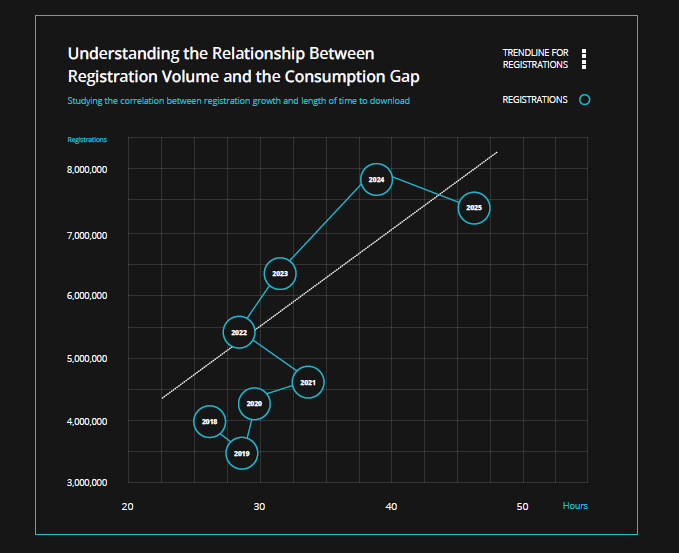
Since 2021, the Consumption Gap has expanded 43.2%. Over that same period, demand for gated content grew 57.6%. These aren’t opposing forces. They are two outcomes of the same underlying reality: buyers want the content…they’re just busier, more distracted, and more overwhelmed than ever before.
The culprit isn’t apathy. It’s a lack of urgency, and urgency, unlike interest, can’t be manufactured.
Which means your content can’t manufacture urgency for a buyer who doesn’t have it yet. But it can do something more valuable: it can make sure that when urgency does arrive (and it will), you’re already in the room.
That’s what the rest of this data is really telling you.
The Two-Clock Problem

Everyone wants their leads to progress as quickly as possible. The problem with this is that your timeline is not their timeline. This simple framework should give an idea as to why.
Clock One starts at registration.
It is in this moment that brand recall is at its peak. They’ve seen the title, they’ve seen your logo (note: if your logo is NOT on the cover of your gated content, fix this immediately), and they’ve thought enough about it to hit submit.
This is the perfect time to go for it, right? Not quite.
Should you reach out? YES! But how you reach out requires tact and finesse.
This is your window to acknowledge their registration, to say hello, and simply let them know you’re paying attention—without demanding anything from them. That’s it.
This is where Jay Baer’s bartender analogy applies: “We’re here when you are ready.”
We’ve written about this before, but here is a practical acknowledgment that asks nothing. Something like: “Thanks for grabbing this—I’ll check back in a few days to hear what you thought. In the meantime, if you have questions, I’m here.”
Once you hit send, give them 48 hours. Catch their eye, then leave them alone.
Clock Two begins when the download occurs.
Once the 48-hour window has elapsed, most buyers will have consumed your content, your follow-up has context, and the conversation has a fighting chance.
This is when the real conversation becomes possible—when they’ve had time to form opinions, identify questions, and understand whether your content speaks to their situation.
Your reps should be reaching out with greater context and supporting content. The goal isn’t to pitch. It’s to begin building a relationship and to better understand the priorities, challenges, and timelines of the registrant. What you learn here shapes everything that comes next.
Clock Three is reality.
This is the clock that hangs in your office, running quietly in the background of everything else from the moment of first registration until the day a deal closes or dies. It’s not something you set or trigger. It just runs.
Confuse the first two clocks, and you’ve either gone completely silent when a light touch would have landed beautifully, or you’ve pushed for a discovery call when someone is still on the first paragraph. Neither outcome serves you or your buyer—and neither outcome moves Clock Three in your favor.
Format Type Is Quite the Tell
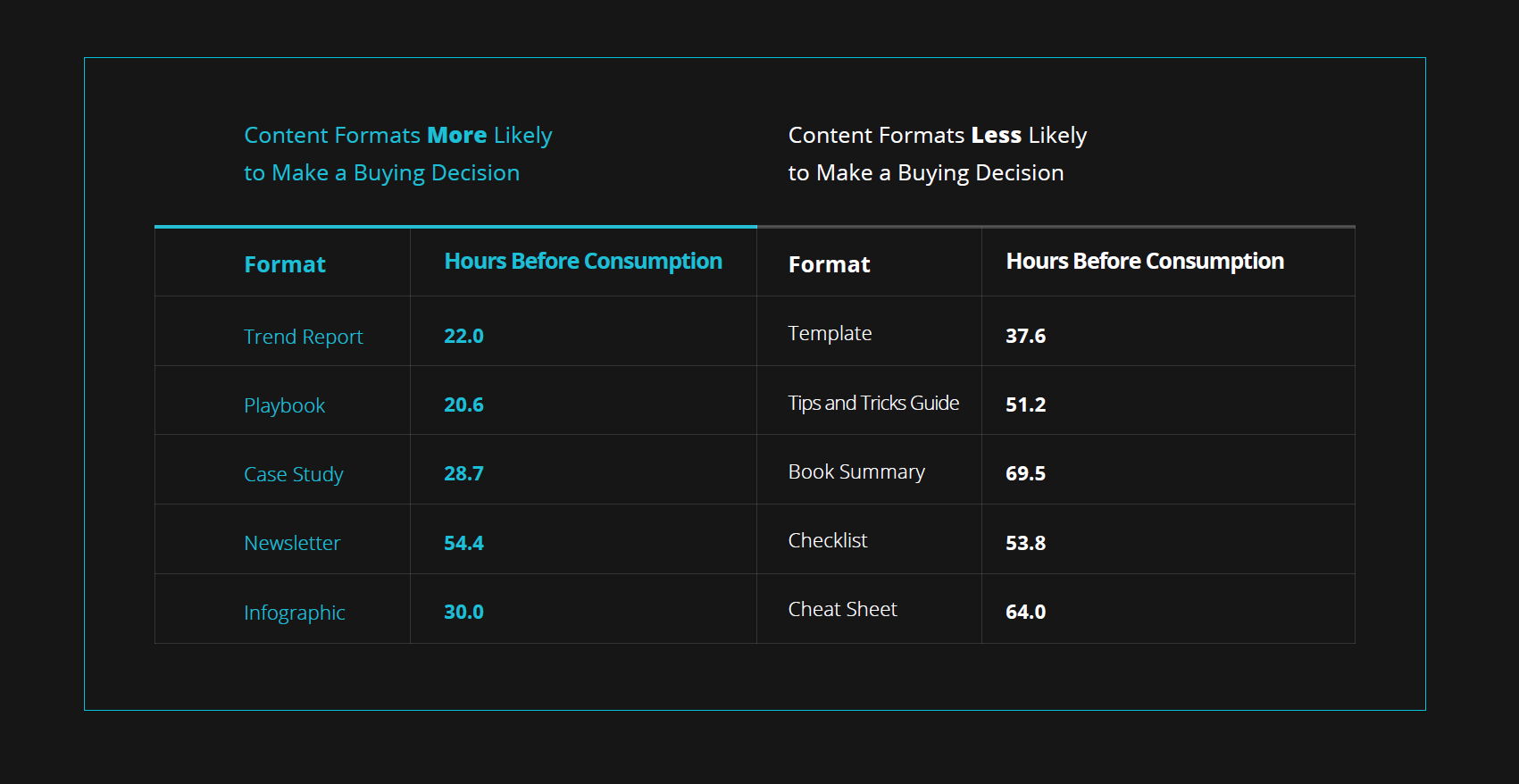
Not every registration is created equal, and the format your buyer chose is one of the clearest signals of where they are. However, it varies dramatically by content format, with each variation carrying real intent signals that most B2B programs are leaving on the table.
Consider the delta between formats most and least associated with a buying decision:
More Likely to Lead to a Buying Decision
- Trend Reports: 22.0 hours
- Playbooks: 20.6 hours
- Case Studies: 28.7 hours
- Infographics: 30.0 hours
- Newsletters: 54.4 hours
Less Likely to Lead to a Buying Decision
- Cheat Sheets: 64.0 hours
- Book Summaries: 69.5 hours
- Checklists: 53.8 hours
- Tips and Tricks Guides: 51.2 hours
- Templates: 37.6 hours
The formats most strongly correlated with near-term purchase intent—Playbooks and Trend Reports especially—are the ones being consumed quickest. When someone registers for a Playbook and opens it within 20 hours, that’s not a passive registration. That’s urgency. That’s a buyer who wanted the answer fast because they have a problem to solve now.
Conversely, a Cheat Sheet sitting in an inbox for 64 hours is telling you something different. The interest may very well be real. But the urgency is non-existent. This is someone you should certainly nurture and keep tabs on, but realistically, don’t expect anything within the next two quarters.
Your follow-up cadence should reflect this.
- A Playbook registrant deserves your attention sooner and with more pointed follow-up.
- An eBook registrant (46.4-hour average) needs more breathing room and a more educational nurture sequence.
Treating them identically is one of the more common and costly mistakes in B2B demand generation.
The AI Connection
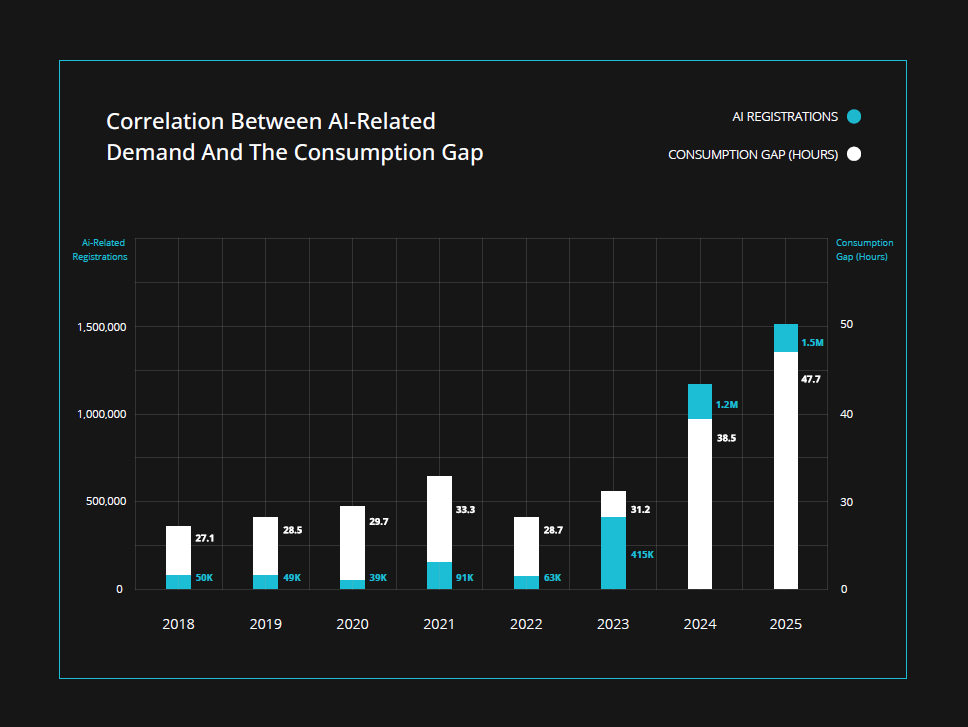
Here’s something the 2026 Report surfaced that should give every B2B marketer pause: the trendlines for AI-related content demand and the Consumption Gap are strikingly similar.
Both began their steepest climb in 2022.
Both accelerated sharply through 2024 and 2025.
In 2025, AI-related content accounted for 21.1% of all demand on NetLine—1.5 million registrations, a 28.5% increase over the prior year. At the same time, the Consumption Gap hit its all-time high of 47.7 hours.
Is AI causing the Gap to widen? Not directly. But it’s a symptom of the same condition.
AI tools, search overviews, and social platforms are now answering questions directly, routing fewer people to the original source—and in the process, compressing how B2B professionals interact with information. They’re consuming more, faster, in more fragmented ways. And when they do find content worth committing to, they register for it… and then they come back to it when they can.
That’s not a bad signal. It’s an informed one.
As we’ve written about before, the disappearance of the easy click doesn’t mean the disappearance of interest. It means the bar for capturing real engagement has gotten higher. And gated content—content someone specifically requests, specifically for themselves—remains one of the strongest proof points that a human being actually wants what you’re offering.
The Job Level Data Doesn’t Lie
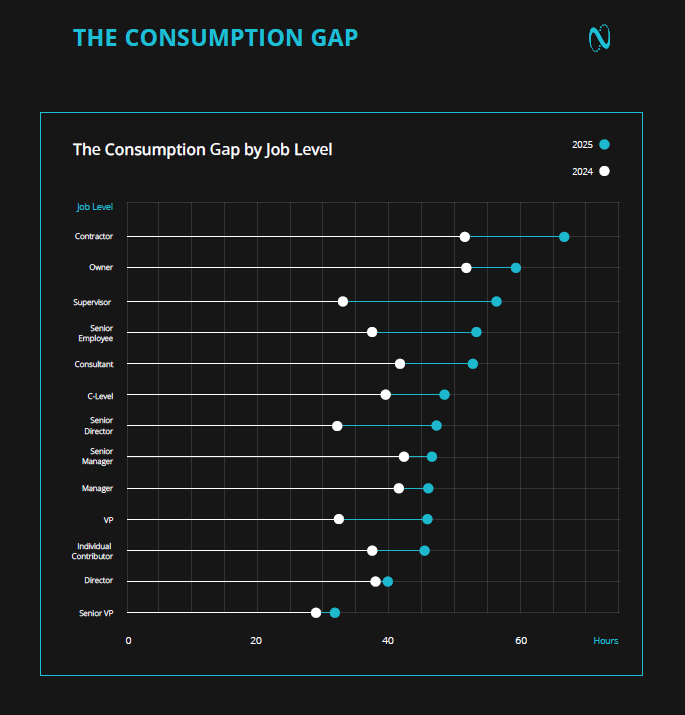
Let’s start with the number that will cause some heartburn in your sales org.
In 2025, C-level professionals had a Consumption Gap of 48.3 hours. It’s not much, but that is greater than the global average.
Owners sat at 59.0 hours. Supervisors at 56.2 hours. The Consumption Gap for VPs and Senior Directors ballooned by 43% and 50% YOY, respectively.
To put it simply, the people with the most decision-making authority—the ones marketers desperately want to reach, and sellers desperately want to speak to—are the ones taking the longest to consume what they’ve requested.
So, what about the flip side?
The job levels consuming content fastest in 2025 were Executive VPs (31.4 hrs), Senior VPs (31.7 hrs), and Directors (39.5 hrs). And while VPs saw a 43% delay increase, they still beat the global average at 45.6 hours.
Let’s consider who those people are in the context of a buying committee. They’re not typically the final signature, but they’re almost always the ones building the internal case, vetting the vendors, and deciding who makes the shortlist. They’re moving faster because they have to. The pressure is on them to come to the C-suite with a recommendation, not a question.
The fastest consumers are signaling their intent through speed, often becoming your most important allies in the early stages of a purchase decision. A Senior VP who opens your Playbook in 31 hours isn’t casually browsing. They’ve made a conscious choice and are simultaneously sending a signal.
The strategic implication is straightforward, even if the execution isn’t: your nurture programs need to account for both. Engage the fast movers quickly and substantively; they’re doing the legwork. Give the C-suite the patience and the proof points they’ll need when the moment finally comes. Because when it does, they won’t be slow at all.
The Consumption Gap Across Industries
While this information may not be in the 2026 Report, the granularity of this industry-level data reveals where buyers are most and least pressed for time.
The fastest consumers, per industry, tend to be in Biotech and Pharmaceuticals (28.1 hours). Agriculture (36.8 hours) and Aerospace/Aviation (41.4 hours) also run faster than average. On the other end, Contractor-heavy segments, Government (51.6 hours), Corporate Services (53.0 hours), and Advertising/Marketing (48.9 hours) sit well above the 47.7-hour average.
If your ICP is heavily concentrated in one of these slower-consuming industries, the 48-Hour Rule isn’t just a best practice—it’s genuinely the floor. Give them more time. Earn more of their patience.
The Registration Is the Signal, Not the Starting Gun

Photo by Atik sulianami on Unsplash
Perhaps the most important reframe in all of this: a registration is research in motion, not a transaction in progress.
The 2026 Report found that nearly half of B2B professionals (45.9%) expect to make a purchase decision within the next 12 months—a 17.7% improvement from 2024. But near-term purchase intent (within 3 months) dropped 15.7% year over year. Mid-range intent, the 6–12 month window, surged 78.6%.
Buyers aren’t saying no. They’re saying not yet.
That reality is only reinforced by Dreamdata’s research, which puts the average B2B customer journey at 211 days and 76 touches before a deal is closed. LLMs and AI overviews may be compressing the time it takes to go from zero to working knowledge on any subject—but there are still far too many variables, stakeholders, and competing priorities in play to expect decisions to move quickly.
All of this means your job right now isn’t to rush users to a decision they’re not ready to make. Your job is to be so consistently present, so genuinely useful, and so clearly attuned to what they’re actually going through, that when the moment does arrive, you’re the obvious choice.
The 48-Hour Rule is the first step toward getting that right. Wait for the gap to close before you try to bridge it.
Ready to dive deeper? Access the full 2026 State of B2B Content Consumption and Demand Report.