For 10 years, NetLine has been reporting on the ebbs and flows of gated content consumption.
In that time, we have seen wild swings (in many directions) across marketing. AI is the latest of these wild swings. If we’re being honest, it’s swung the entire pendulum in a direction that’s recalibrated what “normal” is.
This brings us to our first point from the 2026 State of B2B Content Consumption and Demand Report.
B2B Demand Is Evolving
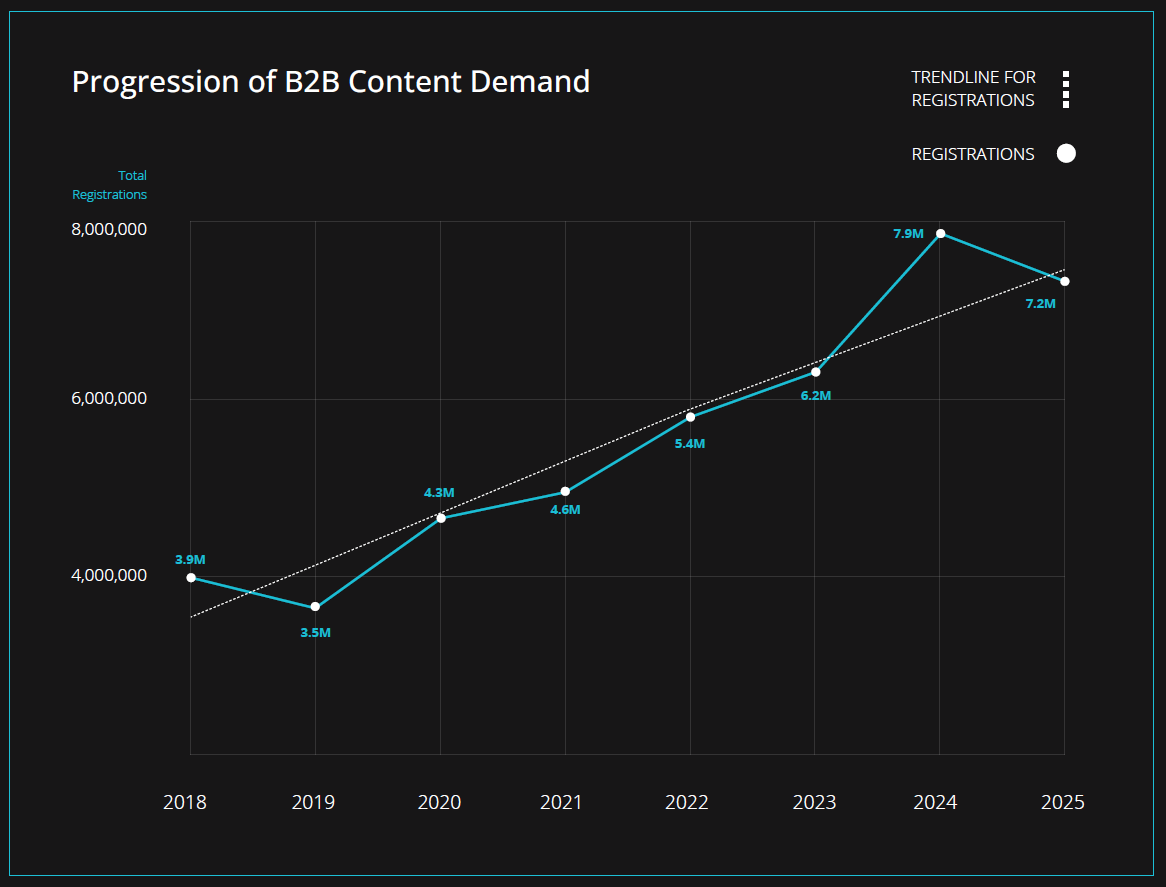
Since 2021, total demand has grown 57.6%, reinforcing that buyers still rely on gated content to research solutions, vendors, and topics of interest.
In 2024, NetLine observed a record number of first-party gated content registrations: 7.9 million, to be exact. Last year was a different story.
In 2025, registrations totaled 7.2 million, dropping 8.6%. Some may see this as a real issue for the future. The reality paints a more nuanced picture long-term.
We’d be wrong to ignore the year-over-year decline, but there are concrete reasons as to why this shift in consumption has happened. Before diving into these reasons, the takeaway is that these registrations now represent more signal and less noise.
The broader digital environment is changing how buyers interact with content:
- AI tools, social platforms, and search engines increasingly answer questions directly.
- This reduces clicks to the original source but does not reduce curiosity or demand for information.
Demand generation programs are getting more sophisticated.
- Client campaigns impact the results we report against. In the words of Ron Burgundy, “It’s science.”
- While you won’t see this in the report itself (we’ll publish an article on this topic in the coming weeks), campaign filters are being honed in more and more.
- Campaign sophistication is limiting WHO is being exposed to a given campaign, thus restricting the total number of leads a campaign can and will generate. This is not a bad thing; it is just different and purposeful.
Ultimately, the goal is no longer optimizing for clicks (or registrations in this case), but rather, capturing meaningful engagement signals. Gated content remains one of the most reliable ways to do it.
AI Has Become Foundational to B2B Content Demand
AI is no longer the shiny new object. It’s become part of the furniture. It might even be building an addition off the kitchen.
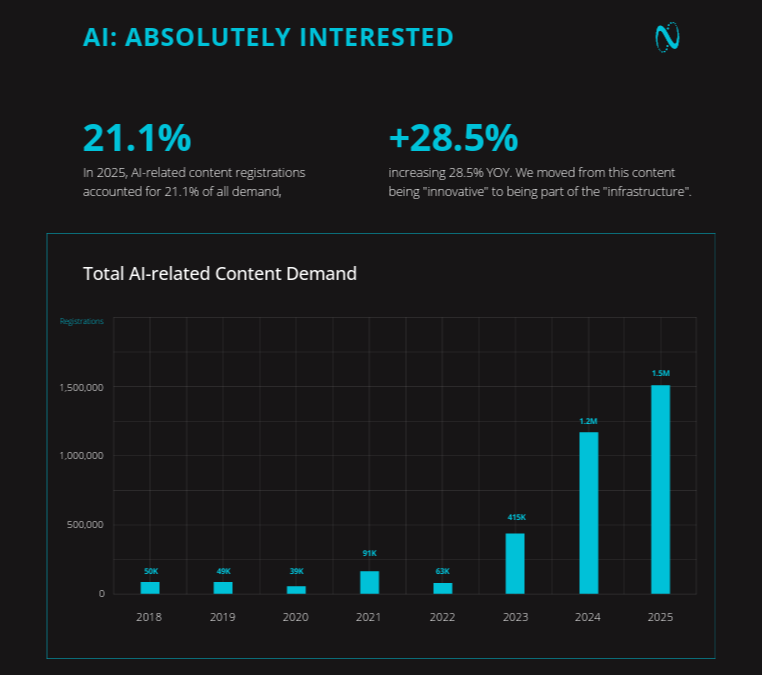
AI-related content accounted for a fifth (21.1%) of all demand in 2025, climbing 28.5% year over year. That’s really quite remarkable. This demand isn’t siloed to one curious corner of the market like IT or engineering, either. We’re seeing every industry, from manufacturing/operations to food and beverage, dip their collective toes into the AI waters.
When interest stretches across this many functions, AI has moved from “innovative” to infrastructural. Audiences expect the ripples of AI to show up inside nearly every conversation about software, automation, operations, and risk.
AI-related consumption is also attracting audiences who are more senior, and the questions are getting more practical. Directors (+26%), C-level leaders (+15%), and managers (+9%) all increased their engagement with AI content in 2025. Meanwhile, the topics gaining traction were less “future of AI” and more “Can we use it this Thursday?” utility: prompt engineering, AI agents, and copilots.
Buyers want to know how AI can change their business today, where it fits, and how quickly they can put it to work. For marketers, that means AI can’t live in a silo. It has to be woven through the broader stories you tell about productivity, transformation, governance, and growth.
The Consumption Gap Continues to Widen
Buyers are taking longer than ever to engage with the content they have requested.
In 2025, the average B2B professional took 47.7 hours to consume the content they requested. That’s a 9.2-hour increase year over year, representing a 23.9% jump. Since 2021, the Consumption Gap has widened 43.2%.
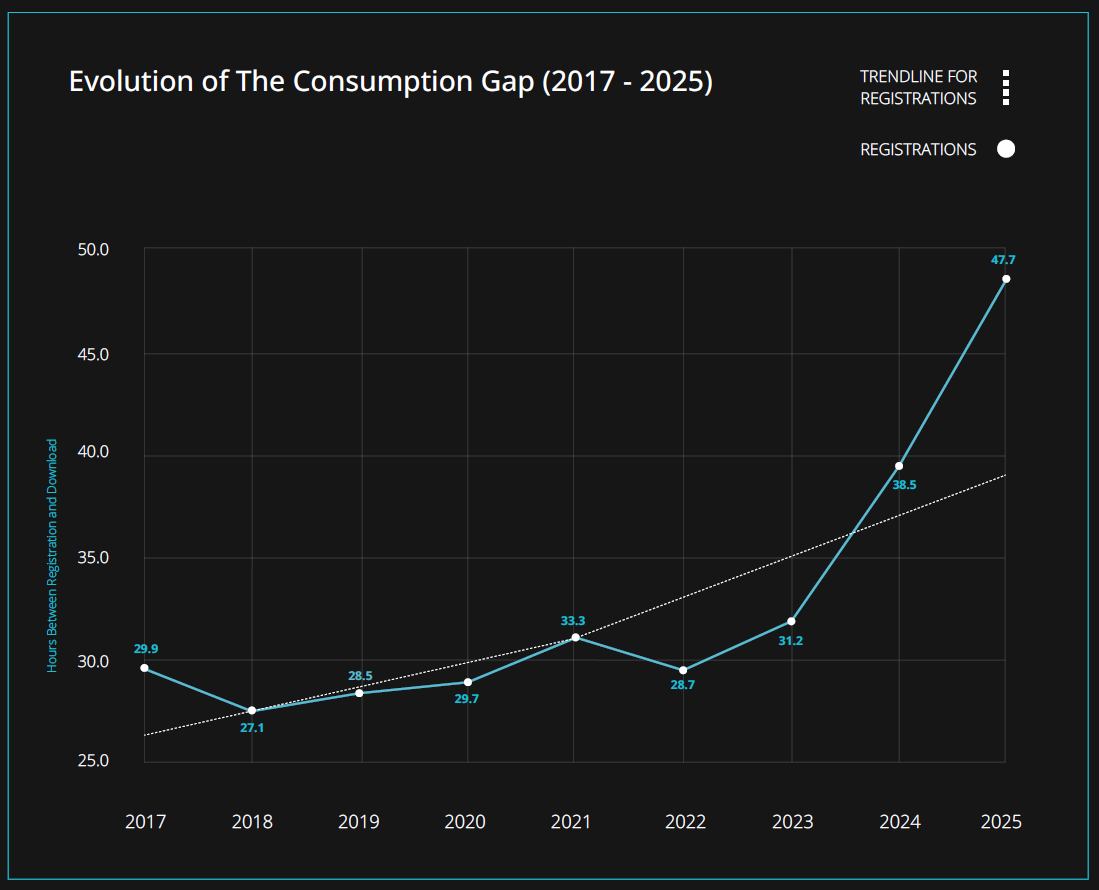
It isn’t enough for buyers to get to your content. Once they’ve asked for it, they then need to engage with it. Two actions for one asset. Some may argue that this is why gated content is inferior to ungated content. On the contrary, we say.
In a world where so much is frictionless, the argument for friction here is quite meaningful.
Fruitful Friction
Within the past year, top voices in our industry have been talking about the benefits of friction.
- Robert Rose wrote about how embracing deliberate friction gives you time to make decisions that lead to standout work.
- Ann Handley has extolled the benefits of going AsAp (As slow As possible)—slowing down at the best moments to deliver the best possible results—since 2018.
- Sean Griffey believes the pendulum has swung too far: that’s it’s so easy to sign up for something that we are losing intent.
All of this to say that the widening of the Consumption Gap isn’t catastrophic. It’s a symptom of the larger changes across our industry, society, and the behaviors of brought about by the distractions all around us.
Why the Gap is Widening
From our perspective, there are three distinct categories as to why it’s taking longer for users to engage with the content they’ve asked to see.
External pressures
- Despite the focus on AI-everything, the workplace feels busier (and perhaps more stressful) than ever. There is greater strain on every department, requiring more attention from every member of the organization.
- This doesn’t just impact those on the frontlines, either. Decision-makers are feeling the constraints of budget restrictions, staffing, and the challenge to find a sustainable path forward. This could also be a factor in why C-Suite consumption rose 4%.
Internal friction
- You got a user to register for your content. Fantastic! But the work’s far from over, and weak calls-to-action won’t do you any good.
- Limited content previews
Market realities
- At the time of publication, things aren’t great across the job market (1.2+ million jobs were cut in 2025, ~60% more than in 2024, and the highest total since COVID) or the economy.
- Because buyers are more skeptical and overwhelmed by tools, channels, and AI‑generated noise, there is intense pressure to prove value with hard evidence.
- Fortunately, the hard evidence these businesses are seeking comes in the form of case studies, ROI data, and live product proof. These content types are terrific bottom-of-funnel pieces that emit phenomenal intent signals even if the registrant isn’t truly ready to purchase.
Mind the Gap
This is the 10th anniversary of the inaugural consumption report. Throughout the research for this year’s release, I stumbled upon something quite interesting from 2017. NetLine’s GM, David Fortino, who was then NetLine’s SVP of Audience, wrote that, “NetLine recommends that when a prospect requests your white paper, sales should wait 48 hours to reach out to discuss the content.”
And here I was thinking I was smart in 2022 for suggesting this.
Dave’s recommendation matters more today than it did in 2017, when the Consumption Gap sat at 36 hours. Today, with the gap just minutes shy of a 48-hour average, NetLine discusses the need for outreach that puts both representatives and registrants in a position for success. Turns out, 2017 Dave knew a whole heckuva lot, too:
Leads generated by long-form content need time to digest your content. Suggest that your sales team wait 48 hours before contacting to ensure that the prospect is well-informed enough to have an educated discussion. This will save your sales team time and reduce poor lead dispositioning…and more importantly, not scare away prospects with immediate contact. In the meantime, your sales team could utilize a light touch email, such as:
“Thanks for checking out our white paper. I’ll check in with you in a few days to see what you thought. In the meantime, please don’t hesitate to reach out with questions regarding XYZ.”
It’s akin to what I wrote about in the Summer of 2025, after my discussion with tequila tycoon and The Time to Win author Jay Baer in A Candid Conversation on Time, Trust, and Buyer Behavior.
“Marketers and sellers need to treat prospective client activities the same way a bartender greets a new guest,” Baer said. “You need to emphasize that, “We’re here when you are ready.”
Even though your registrant likely won’t be downloading/opening/reading your content for another day and a half on average, you CAN (and should!) send them a follow-up email — and you should do so quite quickly.
- The message doesn’t need to make an ask. Just a simple hello that says you’re available when they’re ready, like a bartender who catches your eye the moment you sit down, then leaves you alone until you’re not.
- (Bonus: If you have a related piece of content that speaks to the same challenge, toss it in. Let them keep going on their own terms.)
- What you’re really navigating here is a two-clock problem.
- The first clock starts at registration: brand recall is at its peak, and a light touch lands well.
- The second clock starts when they actually open the content. That’s when the real conversation becomes possible. Confuse the two, and you’ve either gone silent when you should’ve said hello or pushed for a meeting when someone’s still on page one.
Which means success hinges on two opposing forces: speed to acknowledge and patience to let buyers breathe. Get those in rhythm, and the next touch feels helpful, not hurried—or worse, harassing.
- For the buyer: They’re not overwhelmed. They feel seen. They get a preview of value without needing to do anything right away.
- For the business: You get to engage at the moment of highest brand recall (right after registration), while planting seeds for deeper engagement later.
B2B Buyers Aren’t Saying “No,” They’re Just Saying “Not Yet”
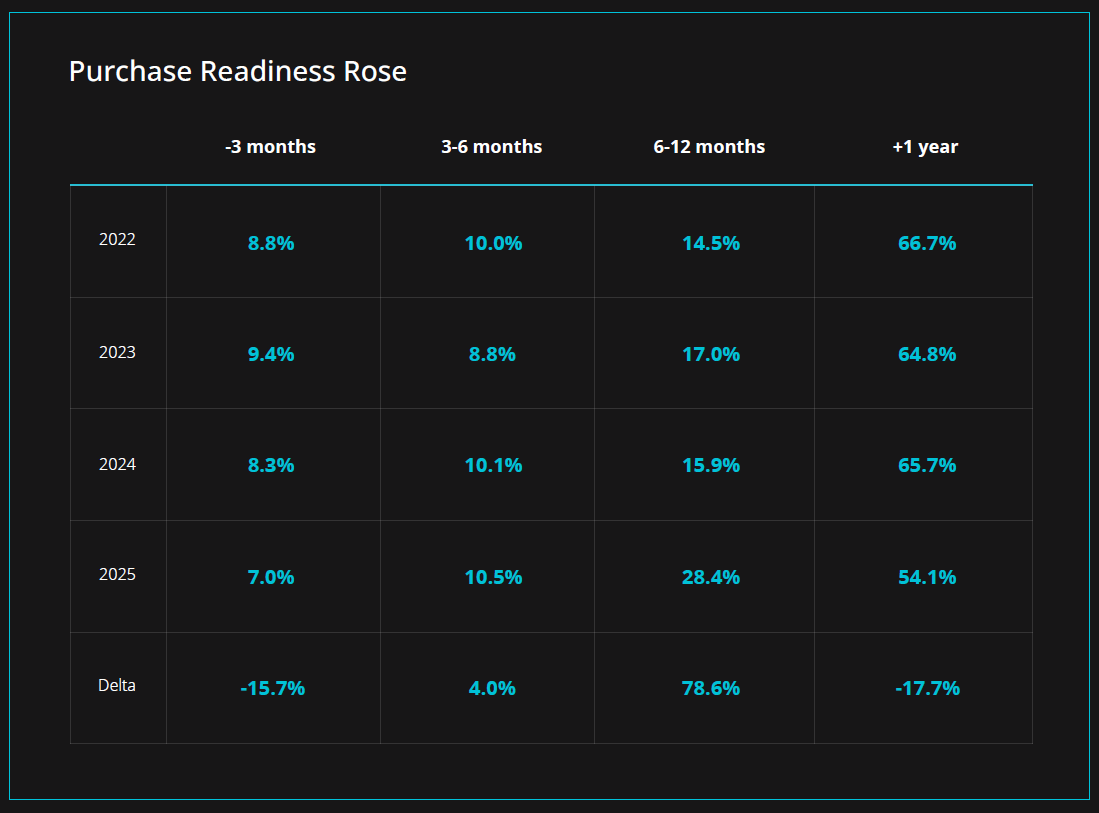
The majority of gated content registrations in 2026 should be treated as a research signal—not an immediate buying signal.
The first reason is that it should have been standard practice years ago.
- Overall, nearly half of B2B professionals (45.9%) expect to make a purchase decision within the next 12 months, a 17.7% improvement from 2024. That’s terrific!
- And while more immediate intent (0-3 months) dropped 15.7% YOY, there’s plenty to be optimistic about for B2B sellers.
The drop in immediate intent segues perfectly into the second reason that content registrations should be treated as a research signal: Purchase timelines are shifting further into the future.
Research from Dreamdata revealed that today’s B2B customer journeys take an average of 211 days and 76 touches before a purchase. This correlates nicely with our own data, as NetLine observed a 78.6% uptick in mid-term (6-12 months) intent. These data points support the idea that even gated registrations are part of the larger research process for B2B professionals.
Clearly, demand hasn’t disappeared. But it has transformed into longer buying cycles, making nurture programs more important than ever.
So who is actually ready and willing to buy?
At the Job Level, C-Level, Owners, VPs, Directors, and Senior VPs are more likely to make a buying decision relatively quickly (0-3 months), with Owners, Individual Contributors, Senior Employees, Executive VPs, and Senior Directors standing out in general.
By Job Area, Executives, Manufacturing/Production/Operations, QA/Safety, Marketing, and Customer Support/Client Services are the groups most likely to buy.
Patience is a virtue. But patience can be tested quite a bit if you’re looking for action. Understand the landscape and prepare your teams to nurture like they’ve never nurtured before.
Content Format Choices Signal Buying Intent
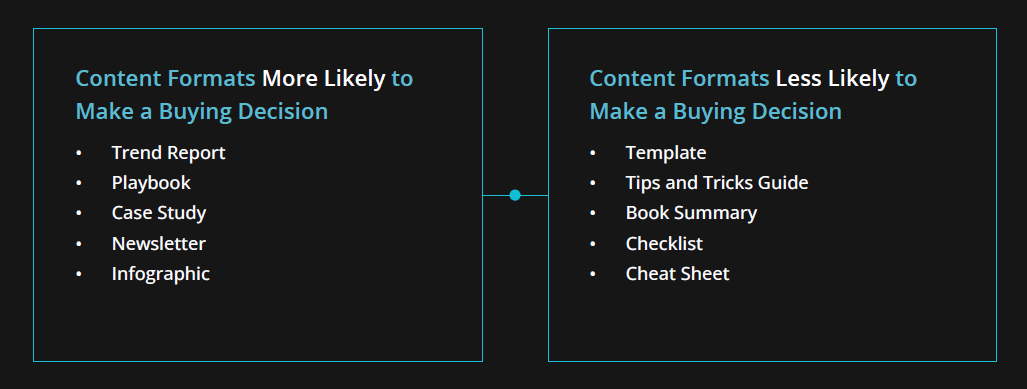
Not every registration is created equally.
In the previous section, we explored why the majority of gated content registrations should be treated as a research signal. The word majority is doing a lot of the heavy lifting in that statement.
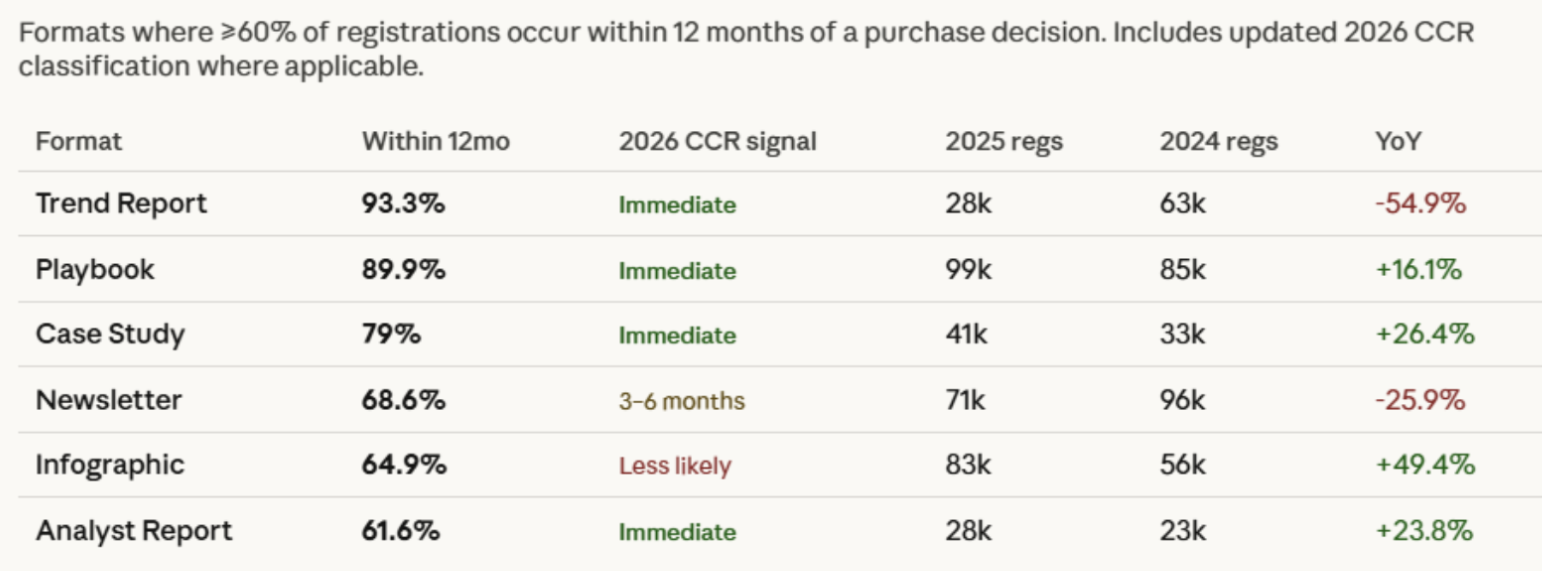
The format B2B professionals choose often reflects where they are in their buying journey. The more thorough and dense a format is, the more likely that asset type is to be associated with a buying decision. Conversely, the more brief an asset type is, the less likely it is to be associated with a buying decision. (Infographics appear to be the one exception to this rule!)
For formats in the More Likely camp, topics that focus on how or when (read when as timing here) seem to be more common than the formats found in the Less Likely camp. On the other hand, content that focuses on what is more often associated with formats that offer surface-level commentary, insights, and/or information. (This is not a hard and fast rule, of course.)
If your focus is on bottom-of-the-funnel intent signals, however, they are the formats you need to be producing and positioning properly:
- Playbook registrations were 101.7% more likely to correlate with a buying decision in the next 3–6 months.
- Trend report registrants were 177% more likely to purchase in the next 6–12 months.
- White Papers were 48.8% more likely to be associated with a buying decision within 12 months, and Guides were 31.5% more likely.
- The strongest near-term formats include Live Webinars, Kits, On-Demand Webinars, Best-Practices assets, and Case Studies.
Different formats should be used strategically throughout the buyer journey—not interchangeably.
Speed of Consumption Matters
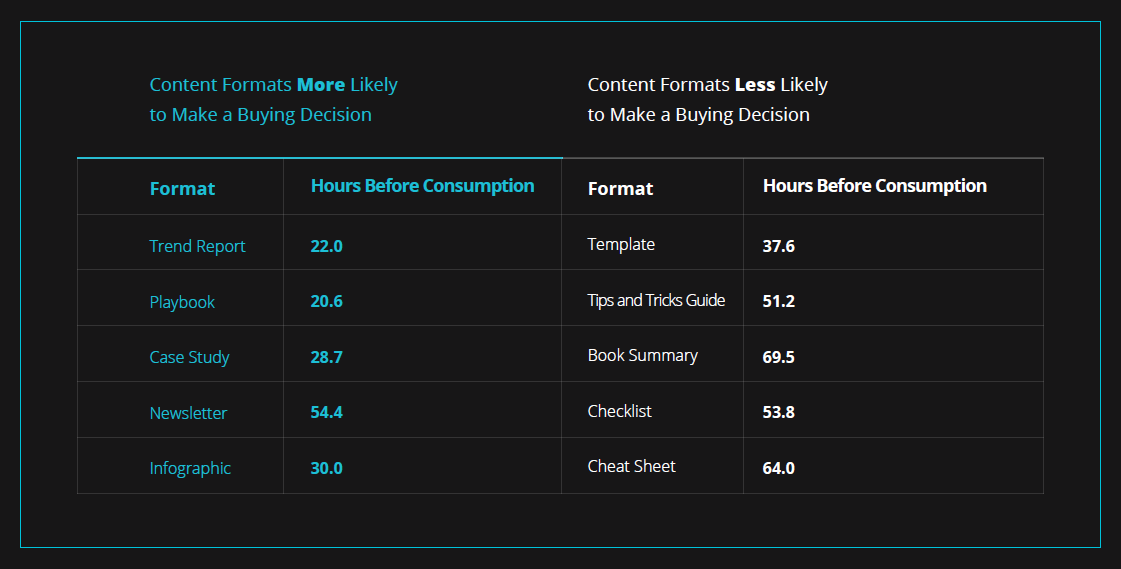
So, just how interested is that lead of yours? The format(s) they choose provide terrific clues.
The speed at which a user consumes the content they’ve requested shows how serious they are about either the subject, their business challenge, and/or the vendor.
For example, on average, an eBook is opened 46.4 hours after registration. Playbooks? An average of only 20.6 hours. Therefore, the faster a registrant consumes a piece of content, the more serious their intent.
This also makes a strong case for having multiple format types within your lead generation campaigns and programs. Without a variety of assets and formats, you won’t be able to greater insight and context into
The Argument for Leaning Into Format Popularity
We’ve written extensively about intent data since 2020. It is an extremely useful measurement of buyer needs and behavioral signals that should serve both the revenue function of a business and the needs of the signaler. Personally, my favorite explanation of intent data comes from our friend Matt Heinz. We asked him about intent data when we saw him in Austin a few years ago.
But intent data is only part of the larger puzzle. And it only works if a signal is both available and found. And given the market conditions in which we find ourselves, having your brand out in the open and being highly visible is quite necessary. It’s a step before intent that Matt has long argued for, too.
In a world where being “known” reigns, visibility and popularity become the currency of influence—shaping perceptions, driving trends, and determining success. Because of this, format popularity must be more seriously considered.
The formats often found on the Less Likely side are more popular with B2B professionals compared to the formats with greater purchase intent. Of the five formats found in the list shared in the 2026 Report, only Playbooks appear in the top 10 for registration volume. Trend Reports were the 23rd most popular format in 2025.
For years, we’ve celebrated the popularity of the eBook, but haven’t ever done much to truly embrace it. That needs to change.
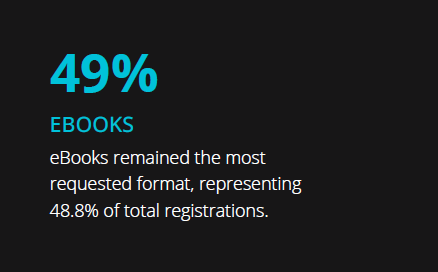
Perhaps the clearest argument on behalf of visibility mattering is the number of registrations per asset. In 2025, eBooks generated about 859 registrations per asset, compared with 63.5 for White Papers.
Marketers have always uploaded more White Papers to NetLine than any other format. Registration volume is lower than that of eBooks, but intent is always higher. That’s the trade-off that many campaigns are happy to make. But as the web gets more bot-centric and humans browse to fewer sites, the need to be seen is paramount.
Therefore, if eBooks are going to remain the rulers of gated content, and there’s no sign of this changing, we should tell everyone to create eBooks with their company logo so they can get in front of more people.
Will it drive the type of bottom-line revenue your CFO is looking for? No.
But when you frame this as a branding investment that will allow your company to get on the consideration shortlist seven months from now, that same CFO will be singing your praises for your forward-thinking decisions.
Format Preferences Are Shifting Toward Depth
There’s something very important for all of us to remember when it comes to gating content: Our buyers can get information anywhere at any time.
We’ve written extensively about the value of original research and how much better it is for your brand and your audience. So, whenever you do choose to package and gate an asset, it had better be darn good. Unless the information you’re offering is unique to your business, they’ve probably already gotten it from an AI overview.
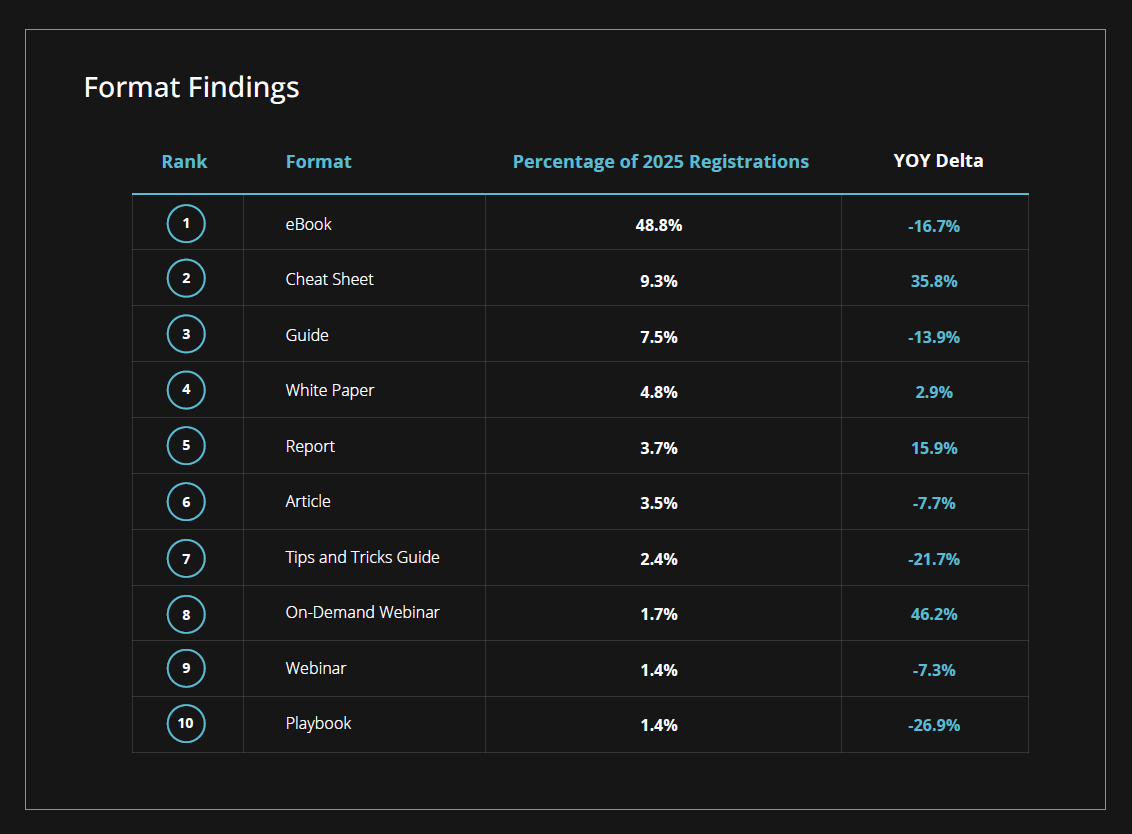
Fortunately, something quite interesting happened last year. B2B professionals began requesting more substantive, strategic content. Fantastic news, indeed!
Additional trend shifts:
- On-Demand webinar registrations grew 46.2%.
- Book summary registrations fell 64.5%.
- Demand is shifting from tactical “quick wins” to strategic, in-depth insights.
Popular formats still reign, but depth and strategic value now have the potential to outperform short, surface-level content.
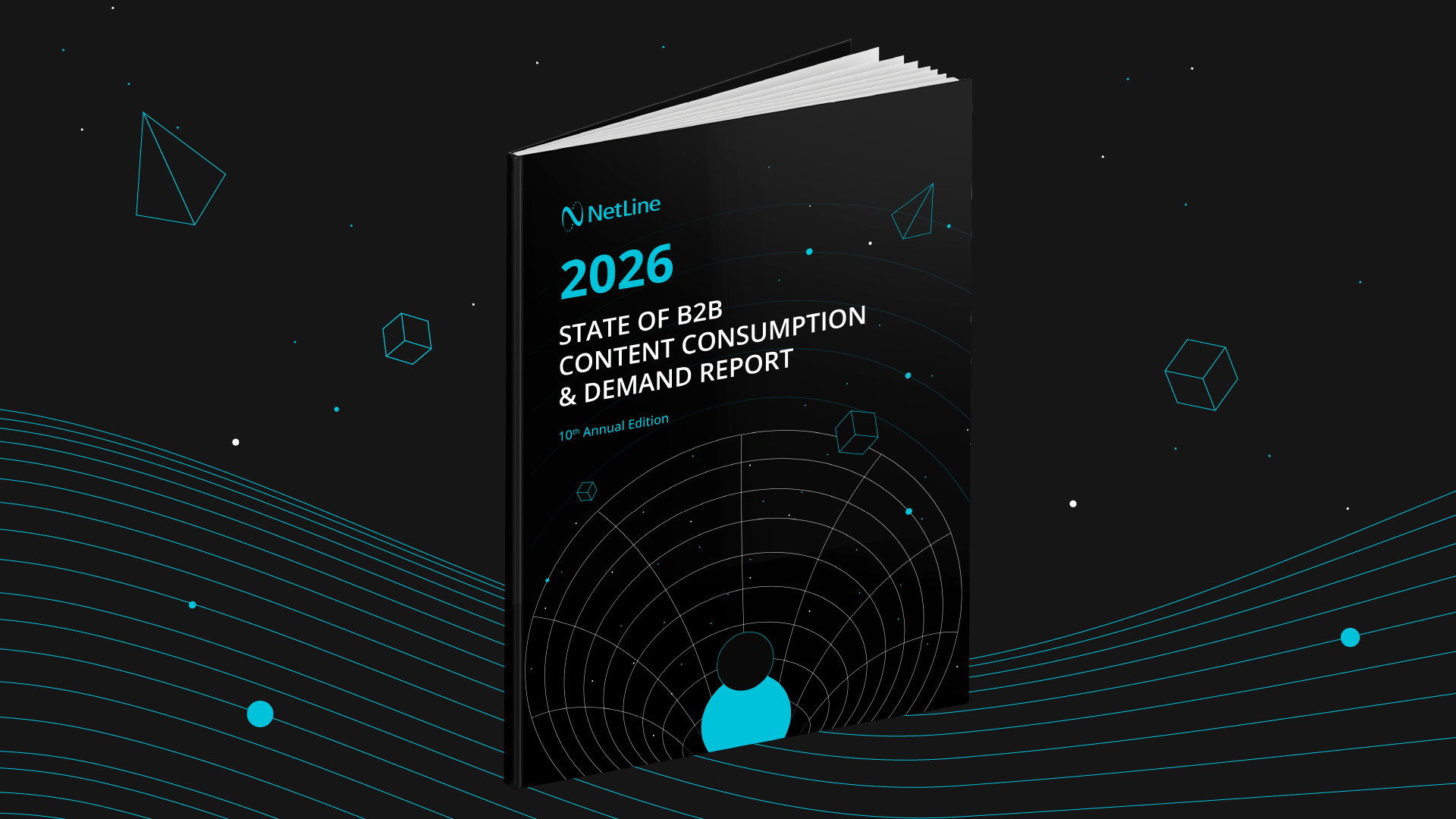
Request Your Copy of the 2026 State of B2B Content Consumption & Demand Report
Consumption is changing, but demand isn’t disappearing.
Buyers are still researching, still registering, and still doing their due diligence for the vendors on their shortlist. They’re just doing it on their timeline.
For marketers, that means adapting strategies around intent signals, longer buying cycles, and content formats that guide buyers from curiosity to commitment.
As you explore this year’s findings, we’d love to hear your thoughts. What surprised you most? How do you plan to adapt your strategy based on this data?
Tag NetLine on LinkedIn with your reflections and questions; we’re here to collaborate and learn together.
Ready to dive deeper? Access the full 2026 State of B2B Content Consumption and Demand Report.