There is no shortage of options in the lead generation market. It’s quite crowded, with each provider offering something slightly different from their competitors.
- Want to generate leads from content? No sweat.
- Looking to leverage the big players like Google and LinkedIn? Go for it.
- How about that new start-up that’s promising the moon? They’ll happily take your money.
But getting leads isn’t the issue. The real issue is generating leads that are genuine, high-quality, and who are actually interested in connecting with you. Getting there requires an understanding of how a lead is procured and the path they and you take to find each other.
So just how different is each player in the market?
The Lead Generation Spectrum
Historically, there have been two distinct ends of the spectrum as it relates to providers today: Publisher Walled Gardens and 3rd Party Scale Providers.
Let’s review each thoroughly.
Publisher Walled Gardens
Examples: (i.e., TechTarget, Foundry, Spiceworks, etc.)

What Makes These Providers Unique
- Premium, strong editorial content, high-quality leads, but challenged with scale and reach.
| Publisher Walled Gardens | |
| PROS | CONS |
|
|
The Benefits
For businesses that prioritize quality over quantity, publisher walled gardens are genuinely appealing—and for good reason.
The leads generated through these platforms are often more relevant and better qualified, thanks to the publisher’s deep understanding of its audience and the controlled environment they maintain. When a prospect engages with content on TechTarget or Foundry, for example, they’re doing so within a professional context they chose. For companies operating in sensitive or highly regulated industries, publisher walled gardens feature more robust data privacy measures than most alternatives, further increasing their appeal.
After all, the point of lead generation spend is to produce highly qualified leads that result in closed-won business. On that dimension, walled gardens deliver.
The Downside
The problem is that quality without scale is just expensive scarcity.
Your campaign is capped by the size of a single publisher’s registered audience. If your ICP extends beyond that ecosystem—and it almost certainly does—you’re leaving coverage on the table with no obvious way to close the gap without adding another vendor, another contract, and another set of minimums on top of it.
The cost structure compounds the issue. Premium CPL rates make sense when every lead converts, but in practice, even high-quality walled garden programs require nurturing, follow-up, and qualification before they reach sales. You’re paying top-of-market rates to begin a process, not to end one.
And over time, the lock-in becomes its own problem. Concentrating your lead generation budget inside a single publisher’s walls limits your ability to respond when your audience’s attention shifts, when pricing increases at renewal, or when a competitor buys the same audience you’ve been cultivating.
3rd Party Scale Providers
Examples: (i.e., DemandScience, Madison Logic, Anteriad, Pipeline360, etc.)

Photo by Johnyvino on Unsplash
What Makes These Providers Unique
- Ability to deliver broad reach and rapid lead generation across diverse platforms at a cost-efficient scale.
| 3rd Party Scale Providers | |
| PROS | CONS |
|
|
The Benefits
3rd-party lead generation providers are the champions of scale and speed.
They offer businesses the ability to cast a wide net, reaching diverse audiences across multiple platforms. This makes them ideal for companies looking to grow quickly or experiment with different channels. The cost efficiency of these providers is another major draw, as businesses can often pay per lead or click, making it easier to manage budgets.
But with great scale comes great responsibility—or, in this case, great challenges.
The Downside
The broad reach of scale providers often results in lower lead quality, requiring businesses to invest more time and resources in qualifying and nurturing prospects.
These providers take questionable approaches to collecting “intent data” (i.e. 3rd party cookies, bid stream, etc.) and then outsource lead generation to 3rd party off-shore lead wholesalers who dial for dollars to try and generate leads at these “in-market” accounts.
Additionally, the reliance on third-party data can raise concerns about accuracy and compliance with privacy regulations like GDPR or CCPA. The lack of control over where ads appear also poses brand safety risks, which can be a dealbreaker for companies with strict brand guidelines.
If you’re working with one of these providers, you’re working with them all as they all use the same data sources and lead wholesales to fulfill their campaigns. These leads do not find your content organically and are forced to accept your content. Bad lead quality and negative impact on your brand.
Where the Spectrum Breaks Down

Photo by Egor Komarov on Unsplash
The spectrum exists because no one has historically been able to occupy the middle of it. Quality lived on one end, scale on the other, and marketers were left to decide which tradeoff they could live with this quarter.
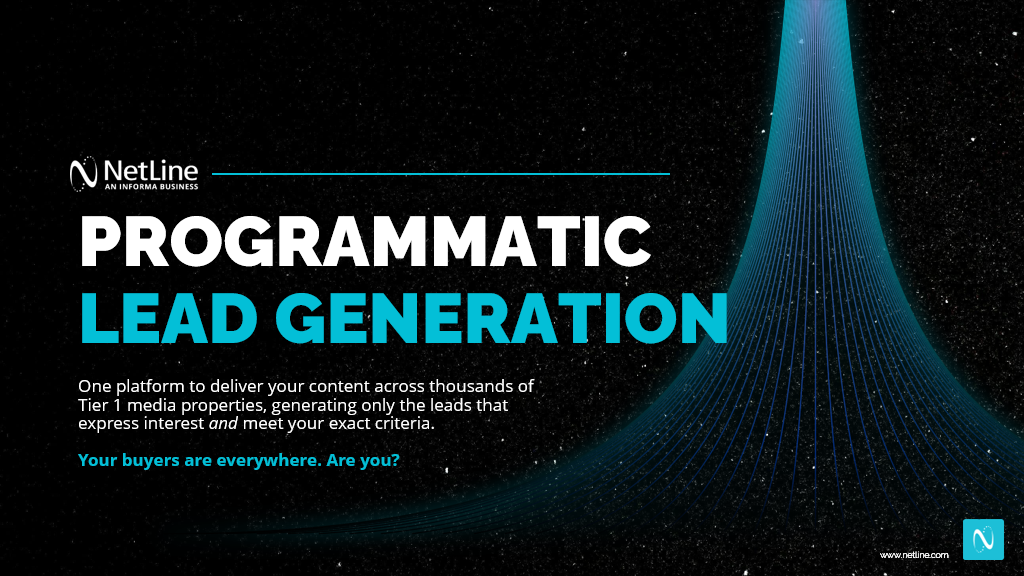
That gap is where the market has been broken—and where NetLine’s Programmatic Lead Generation is specifically designed to operate. Not as a compromise between two imperfect options, but as a different model entirely: one built on first-party data, voluntary engagement, and buyer-declared intent. Here’s how it works.
Programmatic Lead Generation
Examples: (NetLine)
What Makes This Provider Unique
- Precise targeting with verified first-party data and real-time optimization; extensive coverage enables brands to get on the consideration shortlist earlier.
| NetLine Programmatic Lead Generation | |
| PROS | CONS |
|
|
The Benefits
For businesses that want both quality and scale, NetLine occupies a rare middle ground.
Unlike publisher walled gardens, it is not restricted to a single editorial brand. Unlike third-party scale providers, it does not rely on aggregated data, offshore call centers, or manufactured consent. Leads are generated when a professional actively searches for and registers for your content inside a trusted B2B publication—their engagement is voluntary, self-initiated, and documented.
This distinction matters enormously once leads enter your funnel.
A prospect who chose to download your asset remembers doing it, associates your brand with being helpful, and arrives already oriented toward finding a solution. The result is shorter nurture cycles, higher conversion rates, and a sales team that is following up on genuine interest rather than chasing contacts who agreed to a download to end a phone call.
NetLine’s HQL products push this further. Used together, the two products create a full-funnel qualification strategy: Access uncovers who should know you, Precision confirms who is ready to talk.
- HQL Precision embeds custom qualification questions inside your own content experience, so that by the time a lead reaches your CRM, you already know their top business priority, their primary challenge, their investment timeline, and any other criteria you define. These are the buyer’s own words, not inferred scores from black-box models.
- HQL Access operates on the other end of the funnel, identifying net-new in-market buyers across NetLine’s network who match your ICP but have not yet engaged with your brand—giving your sales team a first-touch advantage before those buyers finalize their vendor shortlist.
The Downside
NetLine’s model is content-dependent by design. If your asset library is thin or your content does not speak directly to an active buyer pain point, performance will reflect that. This is not a provider that will paper over weak content with volume.
For highly niche verticals, available audience pools within the network may also be smaller, which can create tension with aggressive lead volume targets on short timelines. In those cases, NetLine works best as part of a broader mix rather than a standalone solution.
With this in consideration, if your current providers are delivering quantity without clarity—high lead counts, low conversion rates, and little visibility into where those leads actually came from—NetLine’s combination of first-party transparency, strict qualification, and buyer-declared intent data is worth a serious look.
The Bottom Line

Photo by Raül Santín on Unsplash
The lead generation market has long asked marketers to accept one of two flawed bargains. Frankly, this hasn’t been a vendor problem, but a structural one. And it doesn’t get solved by adding another provider from the same end of the spectrum.
If you’re already running programs with one or more of these providers, you’ve felt the tradeoffs firsthand.
- The walled garden that delivers quality but can’t give you the volume your team needs.
- The scale provider that fills the spreadsheet with names your sales reps spend weeks trying not to forget.
The question worth asking isn’t which of your current vendors is performing best. Rather, it’s about whether the model you’re buying from can deliver what you actually need: qualified buyers at scale, with enough context for your sales team to have a real conversation from the first touch.
If the answer is no, or if you’re not sure, that’s the audit worth running. And it’s exactly the gap NetLine was built to close.